Your life isn’t complete? Read this English version of my interview by The Editors Club!
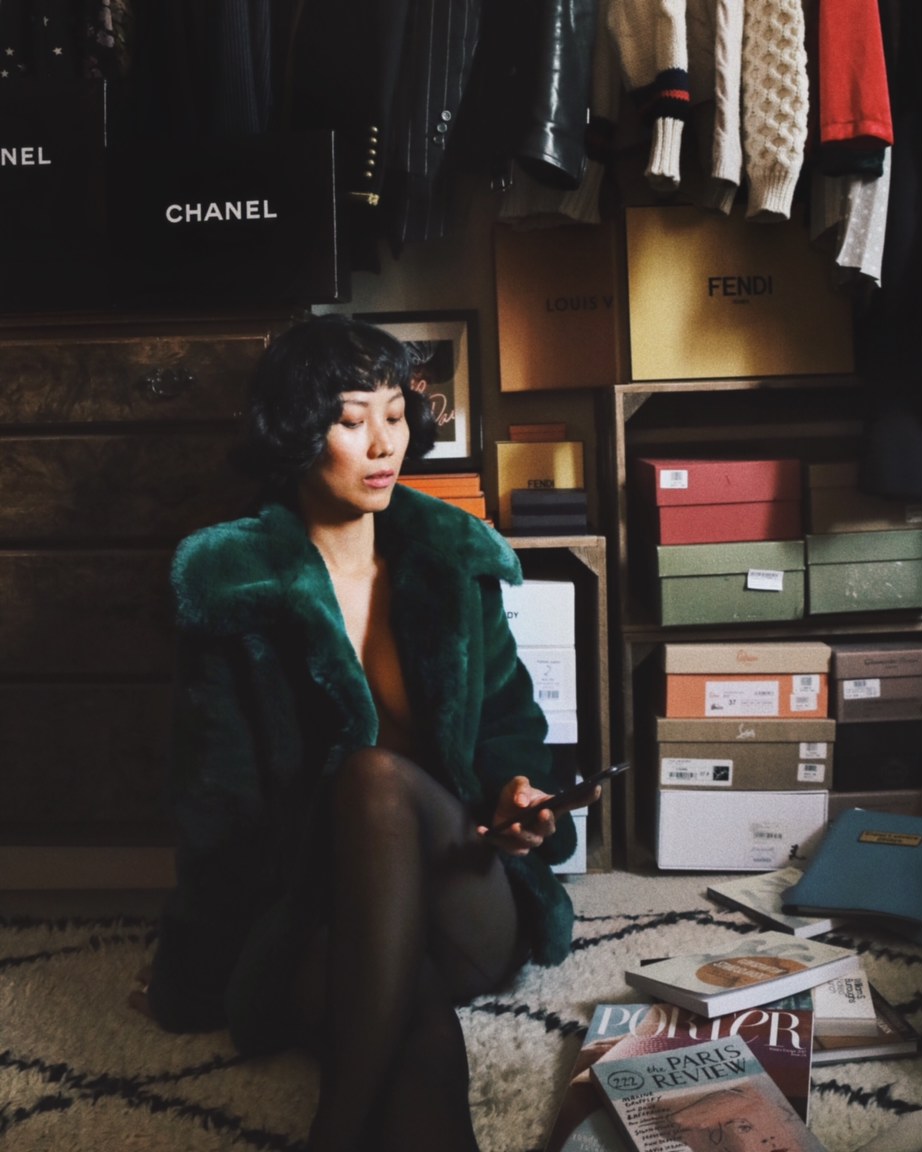
A career to be a writer is not easy. Living it constantly requires consistency and inspiration. TEC talked with Dina Oktaviani, an Indonesian poet who now lives in England. Starting from the beginning of her journey, her daily inspiration, to her way of looking at life, all affix uniqueness to the personality of the woman who has just completed her first film shoot in Paris. Meet the interesting mind of the ‘dedicated faux Parisian’.
BY ALEXA PICAULIMA
Hi Dina, thank you for having this interview with TEC. How are you?
Hi Alexa, I’m a narcissist so pleasure is all mine. I’m managing, as always, thank you.
Tell me a bit about your background. How did you initially plunge into the world of writing?
I was born in Tanjungkarang in an interesting large family. My late Mama is a woman who was a good cook, a money maker, stubborn and wild who fled from her strict Javanese family at the age of 12 years. Papa is of Chinese descent, a former intellectual gangster boss, so at home there were many interesting books that I was secretly reading from childhood. They finally parted ways when I was a teenager and I grew up as a teenager who was not ‘contemporary’. Instead of reading Aneka Yes! I read Marquis de Sade; not dating, just often had a heavy crush on boys in my head; not hanging out at malls, instead hanging out with the homeless in the local market Pasar Bawah. I think, just like most writers, the beginning of the world of writing is reading, reading texts and reading life.
What inspired you to start writing poetry?
When I was in high school, I joined a professional theater group, Theater Satu Lampung. The director and leader, Iswadi Pratama, is a journalist and a poet. He also had a hawk’s eye that could spot poet’s talent in someone, crazy head talent more precisely. One midnight, after rehearsal, he approached me and said, “Do you want to learn to write poetry?” I thought he asked me that because my acting was crap, but the tone was serious, so I answerred, “yes”. From that time on, I learned to write poetry with Kak Is, his nickname.
You have written several books throughout your career, what was your first big break?
I’m not sure about my first big break regarding the books I published. I just recall the time, long before my first book was published, when my poems were published in Kompas. The editor was still Sutardji Calzoum Bachri , the President of the Poets. It was 2000 if not mistaken, I was almost 16 years old. It was a big deal in Lampung at the time, and I had no choice but to use the money to treat my theater and (much older) poet friends.
In your journey as a writer, are there people who are influential to you, giving lessons like a mentor?
As I just told you, Mas Is (as I call him now) was the first person to introduce me to the world of poetry writing. Then when I moved to Jakarta in 2002, there was Sutardji Calzoum Bachri or Om Tardji. We were very close during my year living in Jakarta, maybe because I was the only one who dared to debate him over and over, and I was just a young kid too. The difference is that Mas Is taught me how to write from techniques to digging the poems that my carnal life had blessed me with within me in a methodical way (although it appeared to look random), while Om Tardji always said that he “will not teach you poetry “, he “will teach you life” in his most relaxed way.
In addition to writing books, you have also translated books from Spanish and English into Indonesian. Do you master a language other than those three languages?
My Spanish is not good at all now, because I never practice it, but I can still understand what read. I am more fluent in English and French now, written and spoken, as I often go back and forth England-France. My Javanese is not bad either, sufficient to just chat with the Sultan (King of Java).
If you can recommend books for people who want to be poets or writers, what books do you choose?
Demian by Hermann Hesse, Zarathustra by Frederich Nietzsche, and Portrait of A Youngman as An Artist by James Joyce. It may seem strange that I recommend these three books because none of them is a poetry book, but it would be even stranger to have a poet inside you and after reading these three books you still cannot write poetry.
Are there any important suggestions that beginners should know about writing?
Lots of reading and writing exercises. Observe people and evaluate life. If all this is done and you still cannot write, just forget it!
“The way I think influences my style.”
Can you tell me about the movie “Cinta Yang Bangsat” (“Love is a Louse”)? Who is the character you play?
There are three love stories in three different countries (Iceland, France, Indonesia) in this film, all three are linked by the characters who are interconnected. I played the character of Bice (Beatrice), an actress and poet who lives in Paris and in a relationship with a rich Indonesian director and producer who also lives in Paris. Bice is an idealist and glorifies freedom, in contrast to the financial establishment and establishment of status.
How about the story about when you were offered to play in this movie?
The story.… I was enjoying my cigarette at home, and a text came from an old camerad Rahung Nasution, “would you help play in my friend’s movie?” Because I am narcissistic, I immediately said “of course!” I didn’t even know what the title was, what the story was about, or who the director would be. After a long distance acquaintance with Amir Pohan, the director, then I asked him why me? He said, “because you’re a writer, used to be in the theater and I like your personal style” – he referred to my Instagram account @imaginedparis.
This is your first experience acting in front of the camera. How is the shooting process? Are there special preparations or exercises in doing your scenes?
The process is very different from the theater process that I once lived. For this small and sudden production film, there was hardly time to rehearse. My preparation was to read the entire script and study the character bit by bit by chatting with the director and script writers (Mas Amir and Rahung) and returning to Paris a month before filming started.
The process was fun and full of madness. I was lucky because our little crew helped each other out. My leading co-star, Chicco Jerrikho, is also a very nice first co-actor. The first time we met, the plan was to chat together with the director at the crew’s apartment in Paris, but I ended up ‘kidnapping’ Chicco. When Chicco got to the apartment, I asked him to go downstairs to the next café where I was waiting alone. We talked a lot together while café-hopping in Paris until late at night. Before take, we usually did not have to discuss anymore, we had come to trust each other.
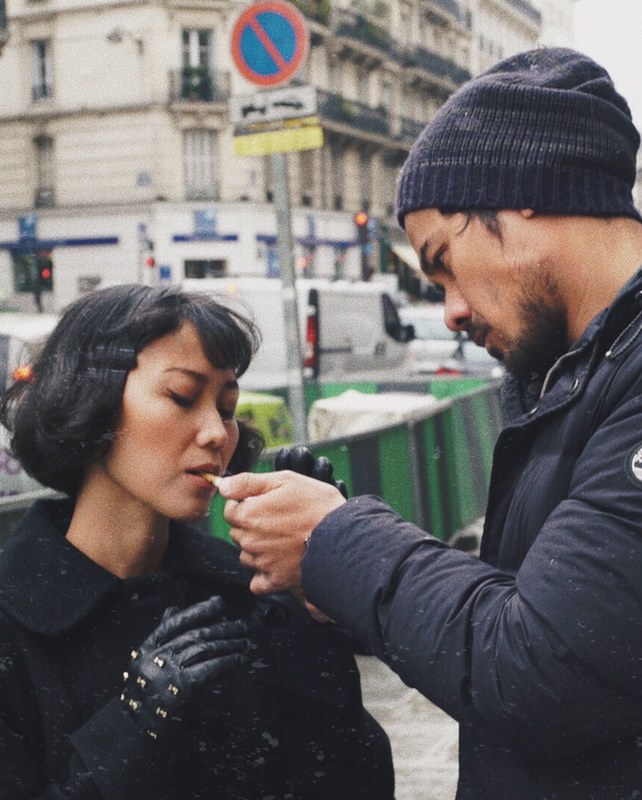
Any interesting incidents during the shooting process?
I am not telling you. Ha ha. Every day of shooting there were interesting events that can’t all be shared just yet. It was a small, intimate crew of strong and diverse characters, so you can imagine the dynamics. One of the interesting things to tell is when it snowed in Paris, all the crew members who were in the middle of enjoying lunch jumped up and got everything ready to take shots and create new scenes so not to waste the snow.
Are you planning to engage again in the film industry?
I don’t know. I’ve never auditioned, nor do I know how the film industry works. But Mas Amir told me to just wait for Gaspar Noë to propose (to play in his movie) after Cinta Itu Bangsat (Louse). Ha ha.
“To me Paris is home. My Parisian life is so lively, so dark, so inspiring.”
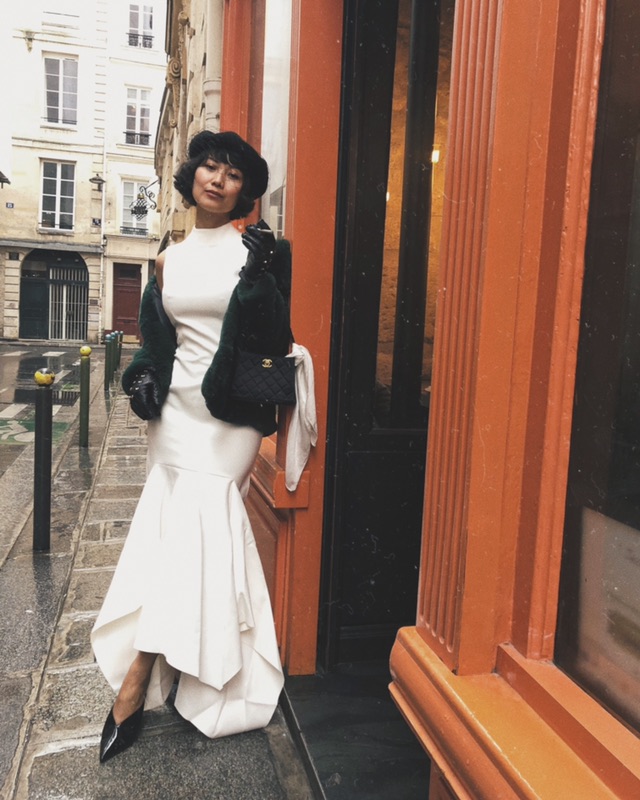
You have such a unique sense of style. Who influenced your style?
The way I think influences my style.
I heard you studied Psychology. What underlies this decision?
Because I’m mentally ill. Seriously, if you’re not and you study Psychology, you are not a genuine Psychology student.
It seems like you travel a lot, what is the experience you remember most when traveling?
Not as much as I would love to, actually. The most memorable experience I can recall now is when three young men mugged me while I was walking through the market after dark back to the riad where I was staying in Marrakech, Morocco. The market was full of people but no one even blinked. Then there was this big, handsome blonde man walking towards us, I immediately ran to him and asked to walk with him. Pure beginner’s luck!
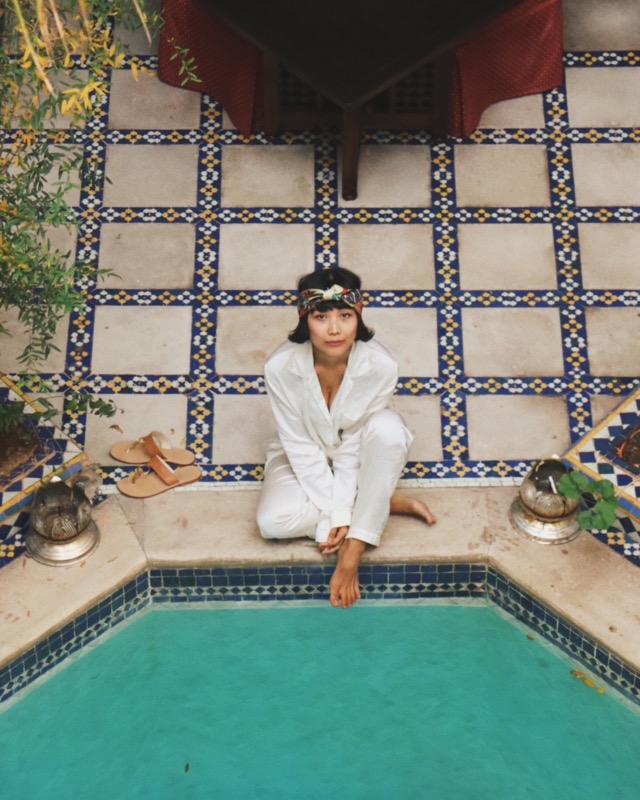
Mention the favorite place or city you have visited. Why?
Paris. Clichée huh? But not those tourists’ Paris. To me Paris is home. My Parisian life is so lively, so dark, so inspiring. There are many places and activities that make Paris stay the Paris that inspired great artists there. Underground cabaret, cave jazz, small bars where brilliant people hang out. Paris’s growth in the direction of ‘modernisation’ is also relatively slow compared to other big cities like London or Jakarta, for example, and that’s a plus for me! And, oh, they speak French there!
Where do you live now? What do you do everyday there?
I live in England since 2012, in Dorset, one of the most beautiful counties in England. Since 2016 I have tried to live in Dorset for several months and in Paris several months each year.
When in Dorset, I usually just lazy about while listening to music in bed, reading, secretly writing, playing Instagram, watching movies or driving through the countryside in my little car with the roof down comes rain or shine. I am also an official translator in the UK, so I occasionally work on a written translation or travel out of town or country to translate orally.
When in Paris, je kiffe, enjoying life! Crawling here and there, from bar to bar, from one jazz club to another, from pyjama parties to more sophisticated pyjama parties, to old cinemas watching old movies, meeting new people, working on translations also because how else am I supposed to afford Chanel bags, and working on small projects such as writing poems and personal journals for Imagined Paris, writing songs with musician friends, or being a faux chef in favourite bars and small parties of friends. I also like walking alone, through the piss-stinking alleyways of Paris, having coffee and drinking alone while daydreaming and watching people pass by.
Out of curiosity, is there a separate story behind the name ‘Imagined Paris’?
The name ‘Imagined Paris’ was inspired by Benedict Anderson’s ‘Imagined Communities’. I fell in love with the concept ‘imagined communities’ since I came across the book when I was in high school. According to Om Ben (his nickname in Yogya) in this book, nationalism was created by the media through images and vernacular. Well, Imagined Paris is an image of Paris that I throw through Instagram as a media to the public for them to pick up. Of course the image I offer is of the Paris I imagine, I breathe, the Paris I am in, the Paris in my head, inside of me.
You’ve written books, played in theater, starred a movie already, what is your next target?
The next target is to become famous, so thank you for this interview!
Click here to see the original publication!
 Imagined Paris